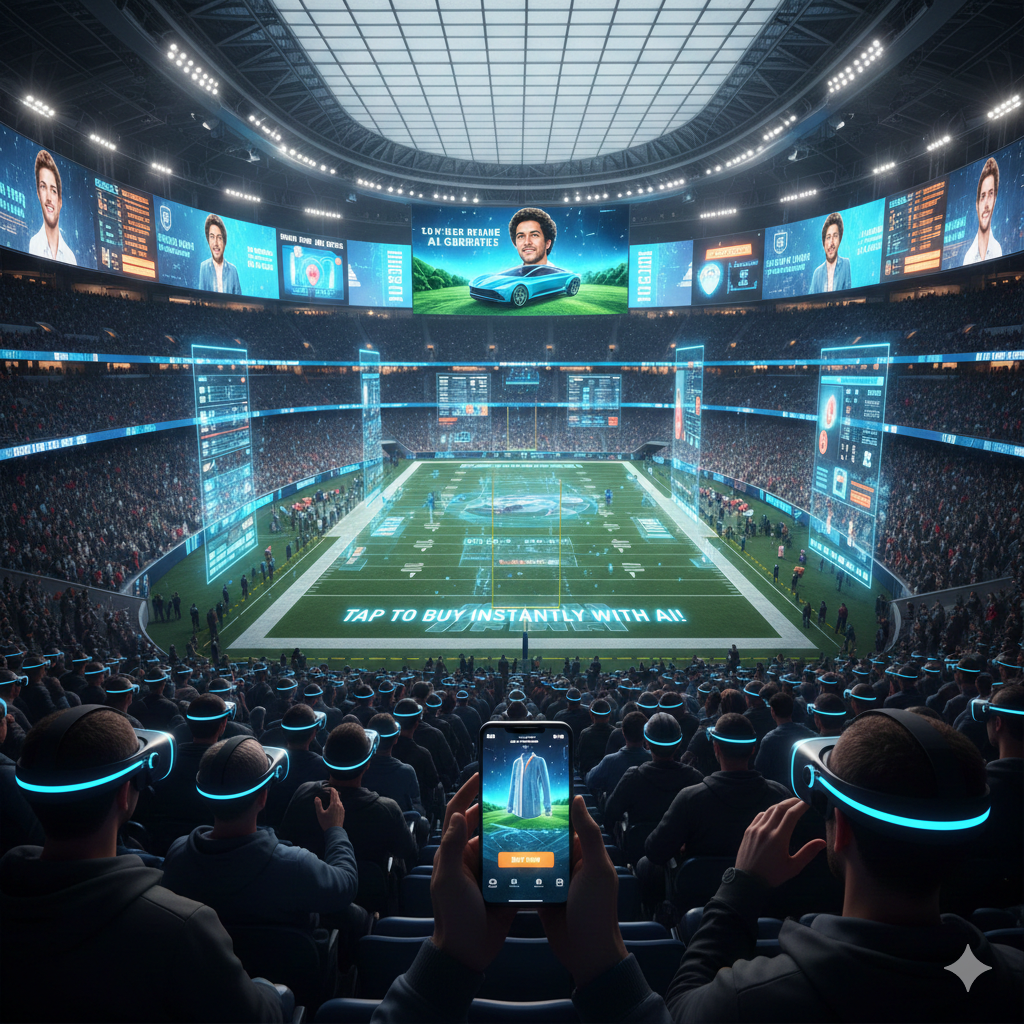
The Super Bowl has always been more than just a football game. For decades, it has been the unofficial “World Fair” of advertising—a high-stakes arena where the world’s biggest brands spend millions for a few seconds of America’s undivided attention. But in 2026, something fundamental changed.
If 2024 was the year of “AI curiosity” and 2025 was the year of “AI experimentation,” then Super Bowl LX (2026) will be remembered as the year Generative AI Advertising took the driver’s seat. From hyper-personalized visuals to scripts written by Large Language Models (LLMs), the commercial breaks were a masterclass in the future of digital marketing.
1. The Shift from CGI to Generative AI
For years, Super Bowl ads relied on expensive CGI (Computer Generated Imagery) and months of post-production. This year, however, viewers noticed a different “vibe.”
Brands like Coca-Cola and BMW utilized Agentic AI workflows to create visuals that were previously impossible. Instead of 500 animators working for six months, creative agencies used advanced video diffusion models to generate surreal, dream-like sequences in a fraction of the time.
The result? Ads that felt more fluid, more vibrant, and—ironically—more imaginative. The “Uncanny Valley” (that creepy feeling we get when robots look almost human) has finally been bridged. The AI characters we saw today looked indistinguishable from reality, making the storytelling feel more intimate.
The Technical Backbone
Behind these visuals are technologies like Neural Radiance Fields (NeRFs) and Gaussian Splatting. These allow advertisers to take a simple 2D photo of a product and turn it into a 3D cinematic experience without a physical camera crew. For tech blogs like FixTech Global, this marks a shift where the barrier to entry for “Hollywood-grade” production has officially collapsed.
2. Real-Time Ad Customization: The “Living” Commercial
One of the most trending topics on social media during the game was the Interactive AI Ad. Several tech-forward brands didn’t just play a video; they played a dynamic file.
Using Edge Computing and Real-Time Data Feeds, ads were able to change their narrative based on the game’s progress:
-
The Comeback Script: If a team was trailing but made a touchdown, the ad aired immediately after would feature a “Never Give Up” message, generated in seconds.
-
The Regional Twist: Viewers in New York saw different background landmarks in the same Nike ad than viewers in California—all rendered on-the-fly by AI.
This level of Contextual Marketing creates a psychological bond with the viewer. It no longer feels like a brand is shouting at you; it feels like the brand is watching the game with you in your living room.
3. The Return of the “Dead”: AI and Nostalgia
Perhaps the most talked-about (and controversial) trend of Super Bowl 2026 was the use of AI Voice Cloning and Deepfake technology to bring back legendary icons.
We saw legendary actors and athletes from the 1970s and 80s appearing in 4K resolution, promoting modern electric vehicles and software. While this raised some ethical debates, the technical execution was flawless. Using Generative Adversarial Networks (GANs), developers were able to recreate the nuances of a human voice and facial expressions with 99.9% accuracy.
The Ethics of “Ghost” Ads
This has sparked a massive debate in the USA about Digital Afterlife Rights. While the tech is impressive, the human element asks: “Should we?” This debate itself is a trending topic, providing perfect “Engagement Bait” for articles and social media discussions. Brands that handled this with respect—by involving the families of the deceased icons—received the highest praise.
4. Why This Matters for Tech Enthusiasts and Small Businesses
Generative AI Advertising: The Future of Brand Engagement
You might be thinking, “This is great for big brands, but what about us?” The Super Bowl is the “trickle-down” event for technology. The tools these big companies used today—like Sora-2, Midjourney v10, and Custom GPT Agents—are becoming available to everyone.
The Democratization of Content
-
Cost Efficiency: AI-driven ads cost about 40% less to produce than traditional high-end commercials.
-
Speed to Market: A concept can go from an idea to a finished video in days, not months.
-
Personalization: Small businesses can now use these same AI tools to create professional-grade content for their own websites.
For platforms focusing on Online Earning, this is a goldmine. People are now making six figures by offering “AI Ad Agency” services to local businesses, using the same tech that was showcased during the Super Bowl.
5. The Human Element: Is AI Replacing Creativity?
Despite the heavy use of algorithms, the most successful ads of the night had one thing in common: A Human Soul. AI did the heavy lifting—the rendering, the coding, and the editing—but the concepts came from human emotions.
The ads that went viral were the ones that made us laugh, cry, or feel inspired. AI is a tool, a very powerful one, but it still needs a “Director” to tell it what matters to the human heart. We are seeing a move toward “Human-in-the-Loop” (HITL) systems where AI handles the labor, and humans handle the empathy.
6. How AI Ads are Changing E-Commerce
The connection between the Super Bowl and “Instant Buy” has never been stronger. In 2026, Visual Search AI allowed viewers to point their phone cameras at the TV during a commercial and instantly find the clothes the actors were wearing.
This integration of AI-driven Logistics and advertising means that by the time the game ended, thousands of products seen in commercials were already packed and ready for drone delivery. This is the ultimate “Online Earning” ecosystem—where interest meets instant fulfillment.
7. Key Takeaways for 2026 Digital Trends
If you are a blogger, a web developer, or an entrepreneur, here is what you should learn from Super Bowl 2026:
-
Hyper-Personalization: Generic “one-size-fits-all” content is dead. Use AI to talk directly to your specific audience.
-
Interactive Content: Users want to participate, not just watch. Whether it’s a poll or a dynamic website element, make it interactive.
-
Ethical Transparency: Always be honest about AI use. The American audience in 2026 values authenticity over perfection.
8. The Future: Super Bowl 2027 and Beyond
Looking ahead, we can expect VR/AR (Virtual and Augmented Reality) to play a bigger role. Imagine sitting on your couch but wearing a headset that puts you on the sidelines, with AI-generated stats floating in the air. The technology showcased today is just the foundation for a fully immersive “Metaverse” sports experience.
Conclusion: A New Era of Advertising
The 2026 Super Bowl has proven that AI is no longer a “futuristic concept.” It is here, it is functional, and it is beautiful. Whether it’s through FixTech Global Official or your own personal projects, embracing these AI trends is the only way to stay relevant in this fast-paced digital economy.
The game on the field was exciting, but the “Game of Innovation” happening in the commercial breaks was the real winner.
If you want to learn more about Artificial Intelligence, be sure to check out our previous article on [AI Basics for Beginners]